

As the metropolitan planning organization, DVRPC is responsible for updating the region's Coordinated Human Services Transportation Plan (CHSTP). The CHSTP update seeks to improve economic and social opportunity in the region by expanding access to essential services for vulnerable populations–those who are more critically impacted by barriers and gaps in infrastructure, service coordination, and policies.
This document was informed by research on best practices and feedback from stakeholders during the project outreach process and looks for new ways to promote affordable, and safe mobility for all. DVRPC's regional plan coordinates and prioritizes investments under the Enhanced Mobility of Seniors and Individuals with Disabilities (Section 5310) program, and also prioritizes regional proposals for funding under the New Jersey JARC (NJ-JARC) program.
The latest CHSTP update focuses on developing and prioritizing projects that may be funded outside of traditional CHSTP funding sources. The CHSTP team has engaged local governments, human services agencies, nonprofits, transportation providers, advocates, and low income, senior, and disabled users to identify unmet mobility needs and service gaps, recommend new or different kinds of transportation access solutions, and enable more people to achieve social and economic mobility.
The DVRPC Board accepted the latest update to the region's CHSTP on January 23, 2025.
We Want to Hear from You!
Getting around the Greater Philadelphia region using transportation services should be easy, whether you’re a senior, traveling with a disability, relying on transit for your daily needs, or trying to get to work. Transit provides opportunities, but it can also create barriers.
Through our survey, residents, riders, service providers, community organizations, and advocates can help identify transportation challenges and opportunities across Greater Philadelphia. Take the survey below and tell us what’s working, what’s broken, and how we can make regional transportation work better for you.
Greater Philadelphia’s Coordinated Human Services Transportation Plan
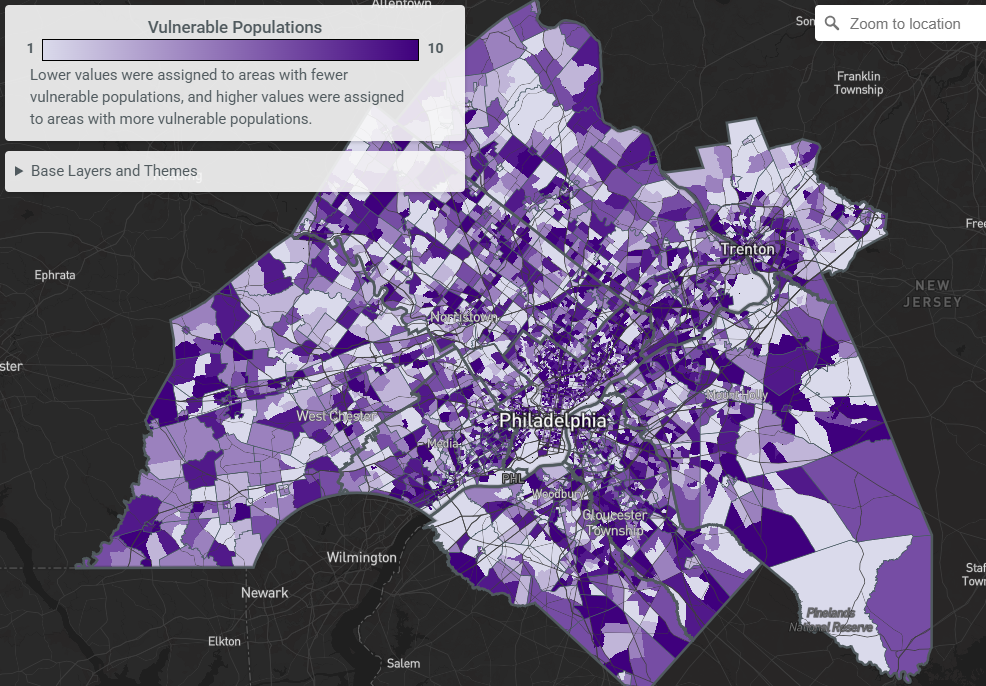
CHSTP Map Toolkit
As part of the CHSTP update, DVRPC created a CHSTP Priority Score Map Toolkit. This interactive web-based tool demonstrates disparities in access to essential services like hospitals, health clinics, recreational spaces, senior centers, and more in the Greater Philadelphia region.
View the map toolkitProject Outreach
In 2020, DVRPC’s CHSTP project team hosted and led many workshops attended by transit users and providers who work closely with residents who rely on low-cost public ADA-accessible transportation. The gaps and bridges outlined in the 2020 CHSTP focused predominantly on transit users. For the 2024 update, the team shifted its engagement and outreach to emphasize conversations with direct and indirect transportation providers with continued input from organizations that work closely with transit users who rely on low-cost, accessible transportation.
The CHSTP team surveyed and interviewed both direct and indirect providers to better understand the challenges and opportunities they encounter in connecting vulnerable communities with essential services and to understand the experiences and needs of these vulnerable communities. Findings from stakeholder interviews, along with input from the project advisory committee and community groups, formed the basis for the “Gaps and Bridges” document that updates the region’s CHSTP priorities.
View survey participants, questions, and responses in Appendices B and C of the 2024 CHSTP.
Gaps, Bridges, and Bold Ideas
The Coordinated Human Services Transportation Plan (CHSTP) is centered around “gaps” and “bridges,” leading to five bold ideas for improving transportation accessibility. Gaps are factors in the region that constrain access to transportation or mobility for vulnerable populations. Bridges are potential solutions, based on case studies and expert opinion, aimed at developing more comprehensive and effective regional transit service and multimodal infrastructure.
Gaps and bridges are the priority needs and strategies for the project and form the basis of the CHSTP. The 2024 CHSTP report identifies gaps and bridges for four different categories: service, funding, data, and service coordination. The gaps and bridges inform the bold ideas, which are a summary of key priorities that transportation planners, policymakers, and accessible transportation providers should address in the next four years.
Bold Ideas
- Update funders' internal policies to allow providers to transport passengers to the nearest essential service in a different county or state.
- Develop policies and mechanisms for providers to support transit users eligible for multiple funding options for one trip.
- Develop data tools and support partnerships between small and large providers that add data management and analysis capacity to small planning and operation teams.
- Prioritize smaller vehicles and partnerships with workforce training organizations to enhance operational capacity.
- Identify new funding options for operating costs.
Next Steps and Other Resources
DVRPC will continue to work on projects geared toward implementation of the bridges and bold ideas identified in the CHSTP. Some completed projects are:
DVRPC LINK
LINK is a tool designed to assist in understanding the potential connectivity benefits of building or improving bicycle and pedestrian infrastructure in the Greater Philadelphia region. Users can draw or upload proposed bicycle or pedestrian facility locations to analyze their connectivity impacts. The tool estimates the number of people, jobs, services, and amenities that would be newly connected by these improvements, offering data-driven insights for prioritizing projects.
AccessScore
AccessScore is an analysis that assesses the infrastructure and demographic characteristics around transit stations that relate to how supportive of bicycling and walking the area is and how much bicycle and pedestrian activity could be occurring there.
Greater Philadelphia Pedestrian Portal
The Greater Philadelphia Pedestrian Portal shows where sidewalks, crossings, and curb ramps exist throughout the DVRPC Region, and where there are gaps. The “Explore” tab shows existing pedestrian infrastructure, while the “Analyze” tab shows where sidewalks are missing. Planners can use the portal to set targets for sidewalk network buildout, and sketch projects.
2020 Coordinated Human Services Transportation Plan
The prior CHSTP update, “Gaps and Bridges” is an outline of issues and needs that vulnerable populations face in accessing essential services in the DVRPC region. This document was informed by research on best practices for accessibility and feedback from stakeholders during the project outreach process.